Posts tagged ‘creativity’
Insights on Creativity from Famous Directors

FAMOUS FILM DIRECTORS AND ACTORS ABOUT CREATIVITY
Creativity is a drug I cannot live without.
Cecil B. DeMille (August 12, 1881 – January 21, 1959), American film director and producer
A hunch is creativity trying to tell you something.
Frank Capra (May 18, 1897 – September 3, 1991), Sicilian-born American film director
Don’t follow trends, start trends.
Frank Capra
If you can dream it, you can do it. Always remember this whole thing was started by a mouse.
Walt Disney (December 5, 1901 – December 15, 1966), American animator, director and screenwriter
It’s kind of fun to do the impossible.
Walt Disney
You can dream, create, design and build the most wonderful place in the world, but it requires people to make the dream a reality.
Walt Disney
Trust your own instinct. Your mistakes might as well be your own, instead of someone else’s.
Billy Wilder (June 22, 1906 –March 27, 2002), Austrian-born American filmmaker and screenwriter
An audience is never wrong. An individual member of it may be an imbecile, but a thousand imbeciles together in the dark – that is critical genius.
Billy Wilder
To be an artist means never to avert one’s eyes.
Akira Kurosawa (March 23, 1910 – September 6, 1998), Japanese film director, screenwriter, producer
Art lost its basic creative drive the moment it was separated from worship. It severed an umbilical cord and now lives its own sterile life, generating and degenerating itself. In former days the artist remained unknown and his work was to the glory of God.
Ingmar Bergman (July 14, 1918 –July 30, 2007) was a Swedish director, writer and producer
Film has dream, film has music. No form of art goes beyond ordinary consciousness as film does, straight to our emotions, deep into the twilight room of the soul.
Ingmar Bergman
A different language is a different vision of life.
Federico Fellini (January 20, 1920 – October 31, 1993) was an Italian film director and scriptwriter
What is an artist? A provincial who finds himself somewhere between a physical reality and a metaphysical one…. It’s this in-between that I’m calling a province, this frontier country between the tangible world and the intangible one—which is really the realm of the artist.
Federico Fellini
Realism is a bad word. In a sense everything is realistic. I see no line between the imaginary and the real.
Federico Fellini
All art is autobiographical; the pearl is the oyster’s autobiography.
Federico Fellini
A film is – or should be – more like music than like fiction. It should be a progression of moods and feelings. The theme, what’s behind the emotion, the meaning, all that comes later.
Stanley Kubrick (July 26, 1928 – March 7, 1999), American film director and screenwriter
If it can be written, or thought, it can be filmed.
Stanley Kubrick
If you can talk brilliantly about a problem, it can create the consoling illusion that it has been mastered.
Stanley Kubrick
What the hell does it all mean anyhow? Nothing. Zero. Zilch. Nothing comes to anything. And yet, there’s no shortage of idiots to babble. Not me. I have a vision.
Woody Allen (December 1, 1935),American screenwriter and director
If you’re not failing every now and again, it’s a sign you’re not doing anything very innovative.
Woody Allen
You ought to love what you’re doing because, especially in a movie, over time you really will start to hate it.
Francis Ford Coppola (born April 7, 1939), American film director and producer
Art depends on luck and talent.
Francis Ford Coppola
Anything you build on a large scale or with intense passion invites chaos.
Francis Ford Coppola
I realized I probably wouldn’t make another film that cuts through commercial and creative things like ‘Godfather’ or ‘Apocalypse.’
Francis Ford Coppola
Life is very, very complicated, and so films should be allowed to be, too.
David Lynch (born January 20, 1946), American filmmaker and television director
The concept of absurdity is something I’m attracted to.
David Lynch
I dream for a living.
Steven Spielberg (born December 18, 1946), American film director and screenwriter
Only a generation of readers will span a generation of writers.
Steven Spielberg
You have many years ahead of you to create the dreams that we can’t even imagine dreaming. You have done more for the collective unconscious of this planet than you will ever know.
Steven Spielberg
I actually think one of my strengths is my storytelling.
Quentin Tarantino (born March 27, 1963), American film director and screenwriter
I steal from every movie ever made.
Quentin Tarantino
When I’m writing something, I try not to get analytical about it as I’m doing it, as I’m writing it.
Quentin Tarantino
Ellis Paul Torrance – Father of Modern Creativity
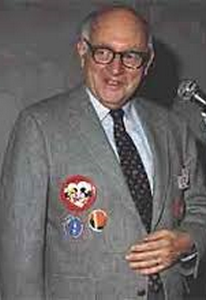
E. PAUL TORRANCE
Ellis Paul Torrance
(October 8, 1915, Milledgeville, Georgia – July 12, 2003, Athens, GA) (Aged 87)
Nationality: United States
Category: Scientists
Occupation: Psychologist, educator.
Specification: He known as the “Father of Modern Creativity”, creator of the Torrance Tests of Creative Thinking (TTCT).
Educational psychology, Psychology of Creativity
Gender: Male
Family: In 1959, at the age of 44, he married Pansy Nigh ( 1913-1988), his nursing student and later a nursing educator and his willing supportive and partner.
Education: Bachelor of Arts (1940) Mercer University, Master’s degree in educational psychology (1944) University of Minnesota, Ph.D. (1951) University of Michigan.
Career: In 1936 he began his teaching career at Midway Vocational High School and in 1937 at Georgia Military College. In 1945, he drafted by U.S. Army and became a counselor of disabled veterans at the University of Minnesota Counseling Bureau. In 1951 he became a director of the Survival Research of the U.S. Air Force in Colorado In 1958, he returned to the University of Minnesota and served as director of the Bureau of Educational Research until 1966. He had been the head of the Educational Psychology Dept (1966 – 1978), and professor (1978 -1984) at the University of Georgia (UGA). He retired from Georgia in 1984. In 1984, the UGA established the Torrance Center for Creativity and Talent Development.
Personality: Torrance had a kind, gentle and generous character. He was an eminence mentor and teacher and always demonstrated the respect and support for his colleagues and students.
Major contributions:
1. Creativity. Torrance devoted his career to teaching and researching creativity. His interest in creativity emerged in 1937 from his observation that many his difficult student went on to become successful in life and work. During his working for the U.S. Air Force (1951-57), he developed his survival definition of creativity, which stated that a courageous risk- taking is essential for creativity.
Later he defines creativity as “…the process of sensing gaps or disturbing, missing elements; forming ideas or hypotheses concerning them; testing these hypotheses; and communicating the results, possibly modifying and retesting the hypotheses” (1962).
2. Torrance Tests of Creative Thinking (TTCT) or Minnesota Tests of Creative Thinking (MTCT).
2.1. Torrance with his collegues invented the most widely known, The Torrance Tests of Creative Thinking, which was published in 1966. Torrance have used many of Guilfords (1950, 1956) concepts in their test construction. but in contrast to Guilford, he sought both verbal and figural activities and grouped the different subtests of the TTCT into three categories: 1. Verbal tasks using verbal stimuli. 2. Verbal tasks using non-verbal stimuli. 3. Non-verbal tasks.
2.2. He developed a benchmark method for quantifying creativity . At the beginning he used use Guilford’s (1956) four divergent thinking factors: 1. Fluency. The total number of interpretable, meaningful, and relevant ideas generated in response to the stimulus. 2.Flexibility. the number of different categories or shifts in responses. 3.Originality. the number of unusual yet relevant ideas and the statistical rarity of the responses. 4. Elaboration. The amount of detail used to extend a response(1966, 1974).
2.3.Then Torrance decided to enhance the scoring of the figural tests. The third edition of the TTCT eliminated the Flexibility scale from the figural test, but added Resistance to Premature Closure and Abstractness of Titles as two new criterion-referenced scores on the figural (1984). Using this system, the figural tests are scored according to five norm referenced scores and 13 criterion referenced scores . So TTCT-Figural form measures five subscales: (1) fluency, (2) originality, (3) elaboration, (4) abstractness of titles and (5) resistance to premature closure.
The criterion-referenced measures include: emotional expressiveness, story-telling articulateness, Movement or actions, expressiveness of titles, syntheses if incomplete figures, synthesis if lines, if circles, unusual visualization, extending or breaking boundaries, humor, richness of imagery, colourfulness of imagery, and fantasy.
2.4. The newest version of the Torrance Test of Creative Thinking (Goff and Torrance, 2002) measured 4 norm-referenced abilities: 1. fluency, ability to produce numerous ideas relating to the activity. 2. originality, ability to produce ideas which are not generally produced. 3. elaboration, ability to embellish ideas relating to the activity. 4. flexibility, ability to interpret similar stimulus in different ways.
2.5. Torrance and his associates administered the Minnesota Tests of Creative Thinking (MTCT) to several thousands of school children. They also completed the 40-year longitudinal study on creativity, done on 215 students that attended two Minneapolis elementary schools from 1958-1964.
Moreover Torrance is aware that the use of the TTCT, is still not able to measure the essence of creativity, that a high degree of the measured creative abilities only increases a person’s chances of behaving creatively.
3. Threshold hypothesis. Torrance proposed popular model is what has come to be known as “the threshold hypothesis”, which holds that, in a general sample, there will be a positive correlation between low creativity and intelligence scores, but a correlation will not be found with higher scores.
4. Future Problem Solving Program. Torrance created the Future Problem Solving Program and developed the Incubation Model of Teaching, which has now expanded and reached over 250,000 students internationally.
This program stimulates critical and creative thinking skills, extend perceptions of the real world, encourages students to develop a vision for the future, Integrate problem solving into the curriculum, offer authentic assessment and prepares students for leadership roles.”
He wrote: “I have always been interested in empowering children, releasing their creative potential. But first I had to measure that potential. So I have a reputation as a psychometrician, but all along I have worked with the development of creativity” (1989).
Awards: Torrance was the recipient of the Arthur Lipper Award of the World Olympics of the Mind for outstanding original contributions to human creativity, an elected member of Who’s Who in the World.
Hew was a veteran of the U.S. Army and a member of Athens First Baptist Church.
Read more: Genvive
Major works:
E. Paul Torrance had a total of 1,871 publications, including 88 books, 256 parts of books or cooperative volumes, 408 journal articles, and 538 reports, 64 forewords, manuals, tests and instruction materials, that have been translated into more than 32 languages.
1. Torrance, E. P. (1962). Guiding creative talent. Englewood Cliffs, NJ: Prentice Hall. 2. Torrance, E. P. (1965). Rewarding Creative Behavior. Experiments in Classroom Creativity. Englewood Cliffs, N. J.: Prentice-Hall, Inc. 3. Torrance, E. P. (1966). 4. Torrance Tests of Creative Thinking: Norms technical manual (Research Edition). Princeton, NJ: Personnel Press. 5. Torrance, E. P. (1974). Norms-technical manual: Torrance Tests of Creative Thinking. Lexington, MA: Ginn and Company. 6. Torrance, E.P. (1974). Torrance Tests of Creative Thinking. Scholastic Testing Service, Inc. 7. Torrance, E. P. (1979). The search for Satori and creativity. New York: Creative Education Foundation. 8. Torrance, E. P., & Safter, H. T. (1990). The Incubation Model: Getting beyond the aha! Buffalo, NY: Bearly. 10. Torrance, E. P., & Safter, H. T. (1999). Making the creative leap beyond. Buffalo, NY: Creative Education Foundation Press. 11. Torrance, E. P., & Sisk, D. A. (1997). Gifted and talented children in the regular classroom. Buffalo, NY: Creative Education Foundation Press. 12. Torrance, E. P. (1994). Creativity: Just wanting to know. Pretoria, Republic of South Africa: Benedic Books. 13. Torrance, E. P. (1995) Why Fly? A philosophy of creativity. Norwood, NJ: Ablex. 14. Torrance, E. P. (2001). Experiences in developing creativity measures: Insights, discoveries, decisions. Manuscript submitted for publication. 15. Goff, K., & Torrance, E. P. (2002). Abbreviated Torrance test for adults manual. Bensenville, IL: Scholastic. Testing Service, Inc.
Joy Paul Guilford – One of the founders of the Psychology of Creativity
 JOY PAUL GUILFORD
(March 7, 1897, Marquette, Nebraska, USA – November 26, 1987, Los Angeles) (Aged 90)
Nationality: United States
Category: Scientists
Occupation: Psychologist
Specification: Author of a three-dimensional model of the intellect and the concept of the Divergent Thinking. Applied psychology: psychometrics. One of the founders of the Psychology of Creativity.
Gender: Male
Family: His wife – Ruth, his daughter – Joan S. McGuire (Author of the book about her father “An Odyssey of the SOI Mode”).
Education: Guilford graduated from the University of Nebraska. (1918-1924). In 1924 he entered the psychology Ph.D. program at Cornell University, where he studied under Edward Titchener and Kurt Koffka. He was awarded the Ph.D. in 1927.
Career: Guilford taught at the University of Kansas (1927 – 1928), worked as Associate Professor at University of Nebraska (1928 – 1940) and Psychology professor at the University of Southern California (1940 – 1967). In 1941 he entered the U.S. Army and served as Director of Psychological Research Unit No. 3 at Santa Ana Army Air Base.
Major contributions:
1. Structure of Intellect (SOI) or (SI): three-dimensional model.
Guilford proposed that intelligence is not a unitary concept and introduced a three-dimensional theoretical model of the Structure of the intellect, according to which the intellect may be represented by three aspects:
– operation (cognition, memory, divergent production, convergent production, evaluation),
– products (units, classes, relations, systems, transformations, and implications),
– content (visual, auditory, symbolic, semantic, behavioral).
The 5 x 6 x 5 figure provides 150 possible abilities (1955). The final version of the SOI model (1988) was resembled as a cube with 3 dimesions, or 6 x 5 x 6 figure. In this model Guilford introduced some new operations (cognition, memory recording, memory retention, convergent production, divergent production, and evaluation). That yields 180 possible unique abilities, which are correlated with each other.
2. Creativity. Guilford in his 1950 American Psychological Association (APA) presidential address emphasized the central significance of creative talent for industry, science, arts and education and the need for more research into the nature of creativity. He developed a theory of creativity, in which he described creativity as sensitivity to problems (1950); as divergent thinking and ability to generate multiple ideas (1959), creation of new patterns, a transformation of knowledge and meaning or use the functions of objects in a new way (1962, 1967).
3. Divergent thinking. Guilford first proposed the concept of Divergent Thinking in the 1950s and later introduced its developed model as the main ingredient of creativity (1976). Thus he directly associated divergent thinking with creativity, appointing it several characteristics:
1. Fluency (the ability to produce great number of ideas or problem solutions).
2. Flexibility (the ability to simultaneously propose a variety of approaches to a specific problem).
3. Originality (the ability to produce new, original ideas).
4. Elaboration (the ability to systematize and organize the details of an idea in a head and carry it out).
He also emphasized the distinction between convergent and divergent thinking.
4. Psychometric study of human intelligence. Guilford is one of the leaders of the psychometric school of research on intelligence, creativity and personality. He was a pioneer in the development of a system of psychological tests for the study of productive thought and creative abilities of the individual. He designed numerous tests that measured divergent or creative thinking and the intellectual ability of creative people.
Guilford’s methods have been widely used with the practical aim of identifying the creative potentialities of engineers and scientific workers and gifted students.
5. Honors and awards: President of the Psychometric Society(1938); President of the Western Psychological Association (1946); President of the American Psychological Association (1949); Doctor of Laws (University of Nebraska.1952); PhD, Sociology (University of Southern California, 1962), Gold Medal of the American Psychological Foundation (1983).
 Creative Vision
You must be logged in to post a comment.