Posts tagged ‘Modernism’
Max Nonnenbruch: Symbolist Painter from Germany
Max Nonnenbruch
January 25, 1857, Viersen, Germany – March 13, 1922, Munich, Germany (aged 65).
Nationality: German
Occupation: Painter
Influenced by: Nonnenbruch was influenced by the Symbolist movement and the Munich School, which emphasized emotional expression and aesthetic beauty.
Movements: Symbolism, Art Nouveau (Jugendstil)
Styles: Neo-classical. Although he did not fully embrace the avant-garde movements of his time, his work reflected a sensitivity to the changing artistic currents.
Subjects: Portraits, allegorical figures, and mythological themes. Many references to Greek and Roman antiquity can be seen: Greek vases, jewellery, hairstyles, columns and mosaic decorations.
Genres: Historical painting, portraiture
Mediums: Oil on canvas, watercolor

Unique distinction: Nonnenbruch is noted for his ability to blend elements of symbolism with a strikingly decorative style characteristic of the Art Nouveau period. He was associated with the Munich School, a group of artists who were active in the late 19th and early 20th centuries and were influenced by the naturalist and realist movements.
Achievements and the main contribution to Art: He gained recognition for his emotive and decorative works that often featured mythological themes. His paintings were exhibited in prestigious venues and contributed to the popularity of Symbolism in Germany.
Family background: Max Nonnenbruch was born in Viersen, the son of land registry inspector Alwin Nonnenbruch and his wife Karoline, née Gössling. He spent his childhood and early school years in Mönchengladbach. From 1868, the family lived in Bonn, where he attended grammar school. Even as a teenager, he developed the desire to become a painter.

Education background:
From autumn 1875, Nonnenbruch studied for two semesters at the Düsseldorf Academy of Art.
On 2 May 1877, he enrolled at the Royal Academy of Fine Arts in Munich and studied under Wilhelm von Lindenschmit and others until 1879. He also attended the Fine Arts School and the Académie Julian in Paris. In 1880, the artist made several trips to Paris and Italy with his friends painters Hans Olde and Claus Meyer.
Professional work experience:
Max Nonnenbruch became a member of the Economic Association of Visual Artists, chairman of the Künstler-Unterstützungs-Verein München, member of the Allgemeine Deutsche Kunstgenossenschaft and the Münchner Künstlergenossenschaft. In 1889 he was a member of the board of the Munich Artists’ Co-operative, and from 1890 he was also deputy secretary.
In 1896, he wrote the article Modern Art and Robert Fowler for the magazine Die Kunst unserer Zeit.
Throughout his career, Nonnenbruch participated in numerous exhibitions across Europe.
His notable works include “Young Beauty” (1892), “Youth (also Odalisque)” (1897), and “Young Bacchante with Thrysos Staff” (1899)).
He became a prominent figure within the Munich School and contributed significantly to exhibitions in Munich and beyond. His works were
highly sought after by the collectors and regularly reproduced in newspapers and magazines of the time.
The artist exhibited many times in Germany and at the Galerie Heinemann in Nice.
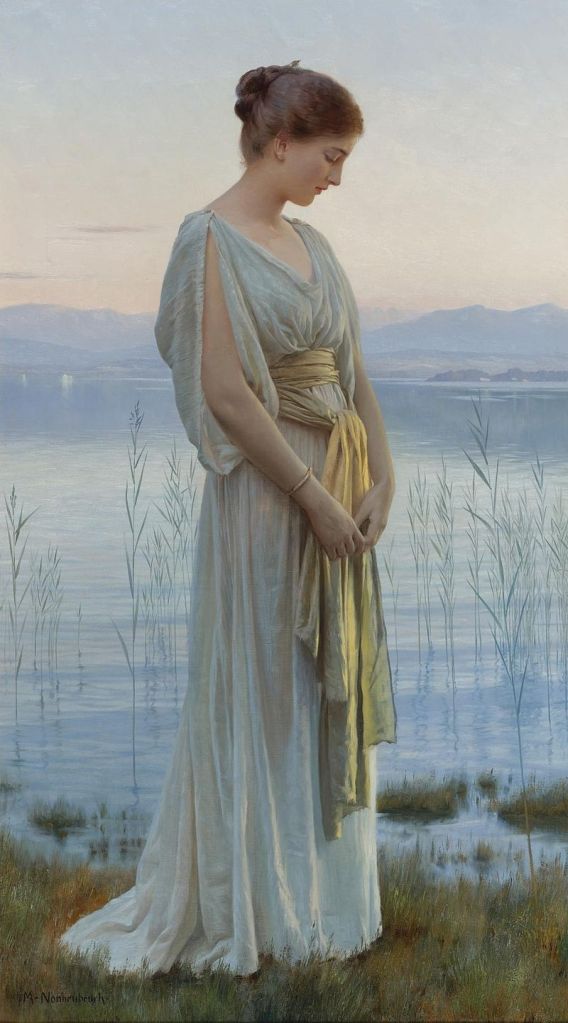
Exhibitions (selection)
1887 Exhibition of the Munich Art Association – The Young Scholar
1888 III. International Art Exhibition at the Glaspalast in Munich – oil painting Portrait and Goldfish
1889 Munich Annual Exhibition of Works of Art of All Nations in the Glaspalast – Oil painting Portrait of My Wife, Portrait of a Lady and Model Break in the Studio
1891 International exhibition organised by the Berlin Artists’ Association on the occasion of its fiftieth anniversary at the Glaspalast in Berlin – Oil painting In the Fir Forest
1895 Great Berlin Art Exhibition – Painting Elegy
1896 International Art Exhibition at the Glaspalast in Berlin – Painting Passionata, first version
1898 Munich Annual Exhibition in the Glaspalast – oil painting Transfiguration
1905 IX. International Art Exhibition at the Glaspalast in Munich – Oil painting Traumbild
1906 Autumn exhibition of the Kunstverein Hannover at the Künstlerhaus
1911 Annual exhibition of Bonn artists at the municipal museum in Bonn – several works
Honours
1893 Order of Merit of St Michael 4th Class awarded by Prince Regent Luitpold of Bavaria for services to the management of the 1893 annual exhibition at the Royal Glass Palace in Munich
1894 Order of Merit of St Michael 3rd Class awarded at the New Year’s Festival by Prince Regent Luitpold of Bavaria.
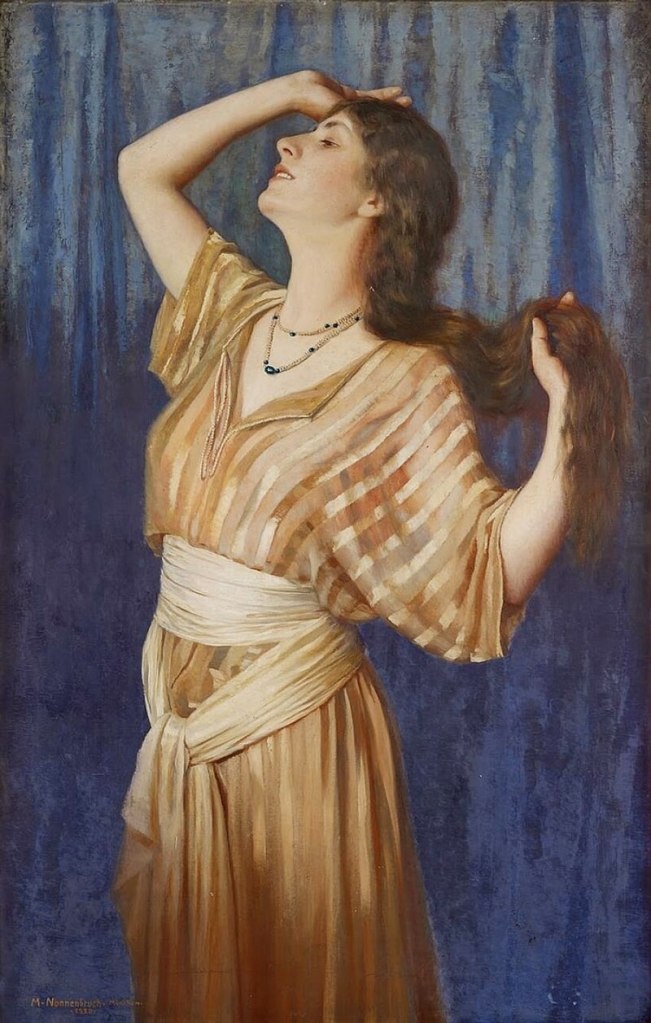
Personal life:
After completing his military service, he met Margarethe Anna Maria Freiin von Welck on Capri in 1894, whom he married on 4 October 1884 in Serkowitz and moved into a studio flat with her at Landwehrstraße 62 in Munich.
In 1899 he moved with his wife to Friedrichstraße and in 1902 to the house he had bought at Mandlstraße 10 in the Schwabing district.
Max Nonnenbruch frequented the Viennese Café Stefanie in Munich for many years and also played chess there.
Max Nonnenbruch had two sons and a daughter with his wife Margarethe Anna Maria, née von Welck (2 February 1856, Liebau – 17 December 1930).
Their son Wilhelm Nonnenbruch was born in Munich on 6 November 1887 and their daughter Marie (1973- 1893), also in Munich. Marie Nonnenbruch married the physicist Eduard Rüchardt (1888-1962).
Interesting facts: There were many editions that appeared in various countries, but more or less good reproductions of his painting motifs are also common on vases or plates. His paintings were also popular postcard motifs.

Young Beauty, 1892



 Creative Vision
You must be logged in to post a comment.